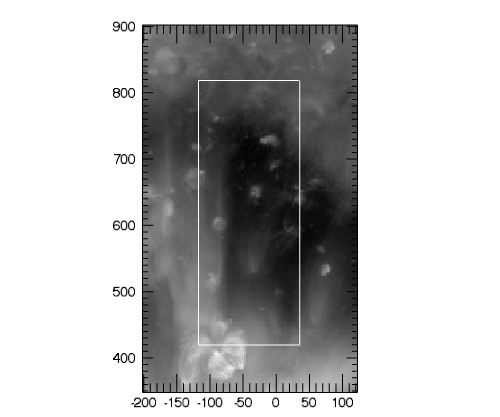
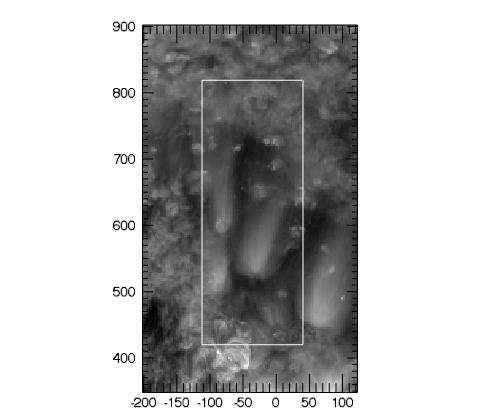
The AIA 193 image (left) below shows the approximate location of the
EIS
field-of-view (white box). You can see that there's a small active
region just below the coronal hole. The AIA 171 image (right) shows
that there are two nice plumes in the FOV.
| |
|
The movie below shows AIA cutouts for a 192" x 450" field of
view (a
little larger than that of EIS). I don't understand the strange
rotating effect near the beginning of the movie. Perhaps SDO was doing
some calibration/engineering study at this time. Also note the wobbling
of the images which is not usual. (I got the cutouts from the JSOC.)
AIA 193 movie (log intensity, 5min cadence, 5hrs, 2.1 MB)
The following jets can be seen:
(+585,+335) @11:00 (AIA image coordinates are clearly wrong
here)
(-60,+660) @ 12:50
(+15,+500) @ 14:20 to 14:40
Here I've fit the Fe XII 195 line with a single Gaussian and made a movie from the 7 rasters. Each frame shows line intensity (left) and LOS velocity (right). I've normalized the velocity map by forcing the average velocity in the top 30 Y-pixels to be zero (I assume this is quiet Sun).
EIS 195 movie (log intensity, and velocity < 20 km/s)
The only significant jet I see in this data-set is in the top-left corner of frame 1. The column of the jet is clearly seen in intensity and was observed at 10:21 UT. Unfortunately this position is missing in the AIA cutouts I downloaded because of the strange spinning effect.
You'll notice that the coronal hole is mostly blueshifted, but also there is a large, curved, blue structure that moves laterally during frames 2-5. I assume this is some large loop structure associated with the active region.